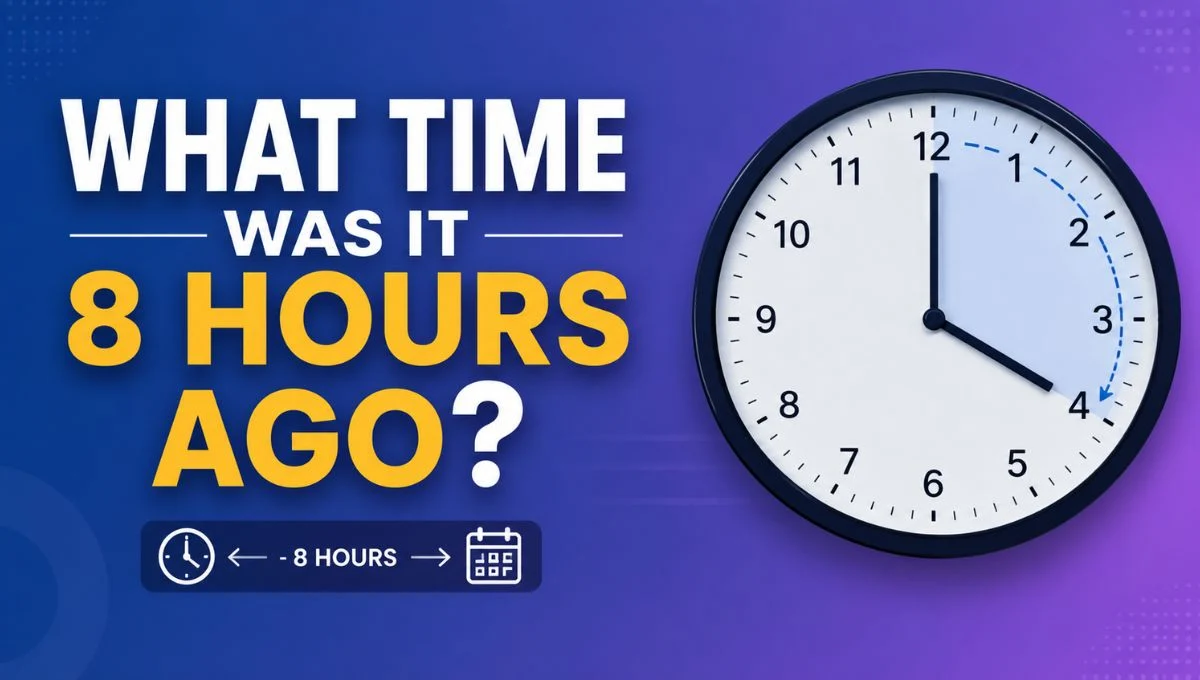
Time has a strange way of slipping by. You look away for a moment, and suddenly the clock shows a completely different hour. If you are wondering 8 Hours Ago from 8:18 AM (GMT+5) on Monday, June 15, 2026, the calculation is surprisingly simple. By moving the clock backward eight hours, you arrive at 12:18 AM on the same date.
This means that 8 Hours Ago was just after midnight, while the current time was 8:18 in the morning. Knowing how to calculate past times can be useful when checking messages, tracking schedules, remembering events, or figuring out when something happened. With a quick subtraction, you can easily determine the exact time from hours earlier.
The Quiet Mathematics Behind “8 Hours Ago”
At its core, figuring this out is basic subtraction dressed up in clock language moving backward on a 12-hour or 24-hour loop.
The simple rule:
- Take the current hour.
- Subtract 8.
- If the result is positive, that’s your answer.
- If it drops below zero (or below 1 in 12-hour format), add 12 and flip AM to PM or PM to AM.
It sounds technical written out, but your brain already does this instinctively.
Why We Even Ask This Question in the First Place
Humans don’t naturally think in raw numbers we think in stories. It’s really shorthand for before dinner, before I woke up, or right after that meeting ended.
People ask for a few common reasons:
- Checking timestamps on messages, emails, or social posts.
- Working out medication or feeding schedules.
- Calculating flight or work-shift timing.
- Verifying activity logs.
- Simple curiosity while scrolling notifications.
The phrase has become a kind of universal timestamp language, especially now that apps show relative time instead of exact clocks.
What Time Was It 8 Hours Ago Central Time
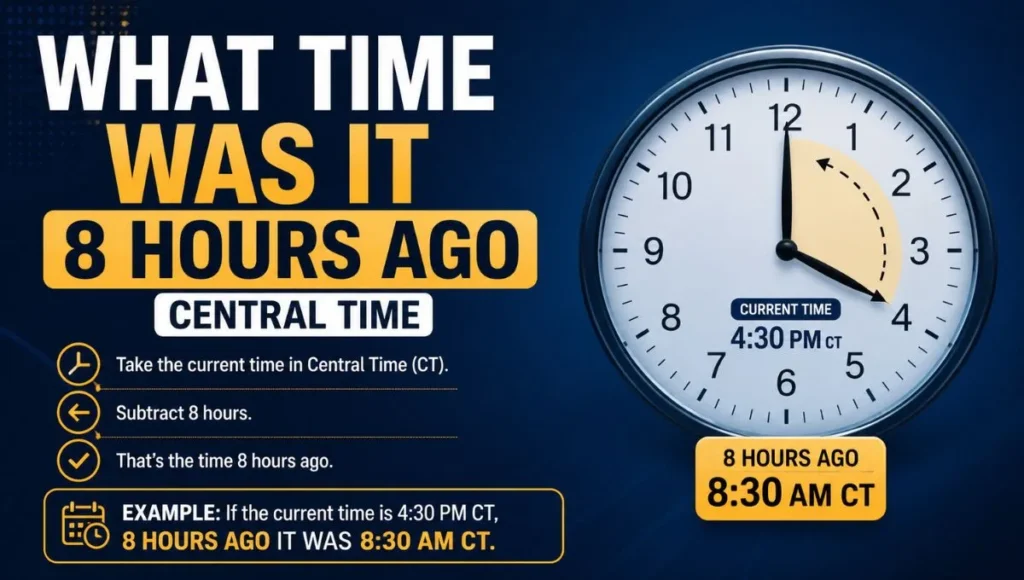
Time zone matters just as much as the number itself. If someone in Central Time asks, the answer depends entirely on the current Central reading.
For example, if it’s currently 6:00 PM Central, then 8 hours ago it was 10:00 AM the same day. If it’s currently 3:00 AM Central, 8 hours ago rolls back into the previous evening around 7:00 PM the day before.
Because Central Time shifts between CST and CDT depending on the season, confirm whether daylight saving is active before finalizing your answer.
Read Also: How Long Until 4:00 PM?
Breaking Down 8 Hours Like a Story, Not a Number
Instead of pure math, picture your day as a timeline. If it’s currently 4:00 PM, walk backward: 3 PM, 2 PM, 1 PM, noon, 11 AM, 10 AM, 9 AM, and finally 8 AM. That’s your answer for 8 hours ago.
This “counting backward on your fingers” method works well for quick mental checks when you don’t want a calculator.
The Role of AM/PM in Time Subtraction
AM and PM are where most people slip up. Subtracting eight hours can silently flip the entire meaning of your answer if you’re not paying attention.
| Current Time | 8 Hours Ago | Notes |
| 5:00 PM | 9:00 AM | Same day |
| 2:00 AM | 6:00 PM (previous day) | Crosses into yesterday |
| 10:00 AM | 2:00 AM | Crosses into early morning |
| 8:00 AM | 12:00 AM (Midnight) | Boundary case |
Notice how the label AM or PM changes almost every time you cross the noon or midnight line. That’s the part people forget.
What Happens When It Crosses Into Yesterday
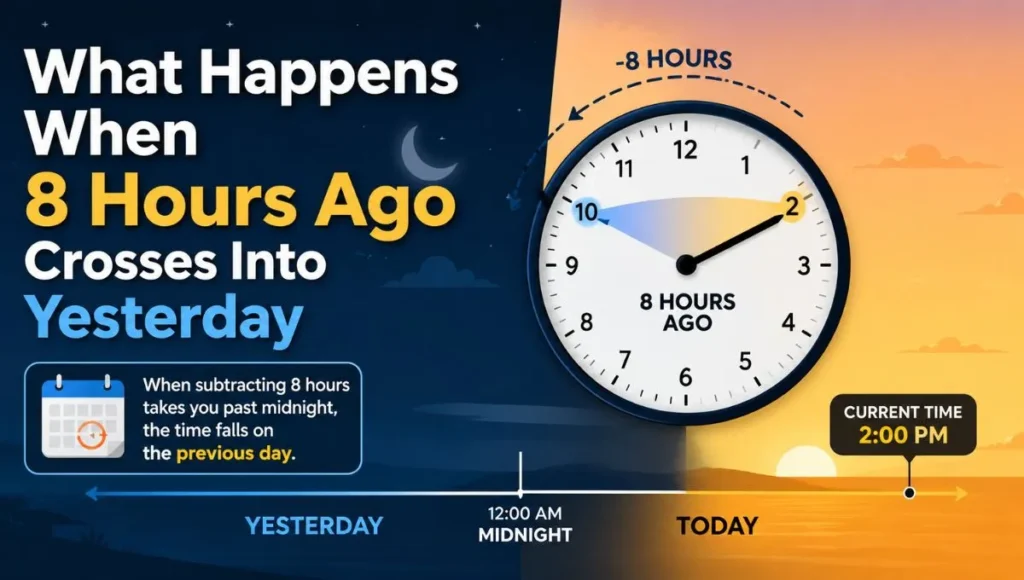
If the current time is earlier than 8:00 AM, your answer for 8 hours ago automatically shifts to the previous day. This trips people up constantly, especially with digital clocks that don’t show the date.
For instance, if it’s currently 3:00 AM Tuesday, the result was 7:00 PM Monday, a full day earlier than most people initially guess.
Across Time Zones: Why the Answer Can Change
Here’s where things get genuinely tricky. This isn’t a fixed universal answer; it depends heavily on where you are.
- Someone in New York and someone in Los Angeles asking what time it was 8 hours ago at the same literal moment will get different clock answers, since their current times differ by three hours.
- International time zone gaps can make 8 hours ago feel like “yesterday afternoon” in one place and “this morning” in another.
- Always match your starting time zone with your target zone before trusting the result.
When Time Becomes Emotional, Not Mathematical
Not every “8 hours ago” question is about logistics. Sometimes it’s emotional checking when a loved one last texted, when a call ended, or how long it’s been since something meaningful happened.
In these moments, the math is secondary. What matters is the feeling behind the number: relief, worry, nostalgia, or simple reassurance that time is passing the way it should.
Read Also: How Long Until 2:30 PM?
Real-Life Situations Where “8 Hours Ago” Matters

- Work shifts – Checking when your shift started.
- Flights – Estimating layover or arrival windows.
- Medication tracking – Confirming the last dose was taken 8 hours ago.
- Social media – Understanding “posted 8 hours ago” timestamps.
- Remote teams – Coordinating calls or deadlines across zones.
How the Calculation Actually Works (Simple Version)
- Note the current time and date.
- Subtract 8 from the hour value.
- If the number goes below 1, add 12 and switch AM/PM.
- If it crosses midnight, move the date back one day.
- Double-check against your correct time zone.
Common Mistakes People Make
- Forgetting to flip AM/PM after subtraction.
- Ignoring the date change when the hour drops below zero.
- Mixing up 12-hour and 24-hour formats.
- Assuming everyone’s “now” matches their own time zone.
- Skipping daylight saving adjustments.
Understanding Time in Different Layers
Time isn’t just clock numbers it’s layered across formats: 12-hour, 24-hour (military), UTC, and local zones. Knowing which layer you’re working in prevents most errors when solving this kind of problem.
A Small Practical Guide for Quick Mental Math
- Round the current time to the nearest hour first.
- Subtract 8 using your fingers or a mental number line.
- Adjust AM/PM only after confirming whether you crossed noon or midnight.
- Recheck once using a phone clock if the stakes are high appointments, medication, flights.
Tools That Help You Do It Faster
Online time calculators, smartphone world clocks, and “time ago” widgets on social platforms all handle this subtraction instantly, removing the guesswork entirely.
Simple Everyday Examples
- It’s 1:00 PM now → 8 hours ago was 5:00 AM.
- It’s 11:30 PM now → 8 hours ago was 3:30 PM.
- It’s 6:15 AM now → 8 hours ago was 10:15 PM yesterday.
Read Also: How Long Until 3:30 PM?
A Tiny Structured Snapshot of the Calculation
| Step | Action |
| 1 | Identify current time |
| 2 | Subtract 8 hours |
| 3 | Adjust AM/PM if needed |
| 4 | Shift date if it crosses midnight |
Why This Question Keeps Coming Back
Because modern life runs on relative timestamps rather than fixed clocks, 8 hours ago will keep showing up in texts, apps, and casual conversation. It’s a small but constant part of how we mentally track our day.
Frequently Asked Questions
What time was it 8 hours ago today?
To find what time it was 8 hours ago today, simply subtract 8 hours from the current local time. For example, if it’s 6:00 PM right now, 8 hours ago was 10:00 AM the same day. If the subtraction passes midnight, the answer falls on the previous day.
What time was it 8 hours ago in Central Time?
To calculate 8 hours ago in Central Time, use the current time in the Central Time Zone and subtract 8 hours. For example, if the current Central Time is 4:00 PM, then 8 hours ago in Central Time was 8:00 AM.
What time will it be 8 hours from now?
If you want to know the time 8 hours from now, add 8 hours to the current time instead of subtracting. For example, if it’s 9:00 AM now, then 8 hours from now will be 5:00 PM.
What was 8 hours ago from 7:00 AM?
If the starting time is 7:00 AM, subtracting 8 hours gives 11:00 PM on the previous day. This happens because 8 hours goes back past midnight.
What time was it 8 hours ago in EST?
To find 8 hours ago in Eastern Standard Time (EST), take the current EST time and subtract 8 hours. For example, if it’s 3:00 PM EST, then 8 hours ago was 7:00 AM EST.
What was 8 hours ago from 6:00 AM?
If the current or starting time is 6:00 AM, then 8 hours ago was 10:00 PM on the previous night. Since the subtraction crosses midnight, the date changes as well.
What was 8 hours ago from 3:00 PM?
Starting from 3:00 PM and moving back 8 hours lands at 7:00 AM on the same day. This is a straightforward subtraction because it does not cross midnight.
What time was it 8 hours ago in GMT?
To calculate 8 hours ago in GMT, use the current Greenwich Mean Time and subtract 8 hours. For instance, if it’s 2:00 PM GMT now, then 8 hours ago was 6:00 AM GMT.
Conclusion
Working out 8 hours ago is one of those small daily calculations that feels tricky only until you see the pattern behind it. Once you understand the AM/PM flip and the midnight rollover, the math becomes second nature.
Whether you’re checking a timestamp, a flight, or a memory, knowing this simple trick saves confusion and keeps your day organized..

I’m an experienced content writer with 7 years of experience creating heartfelt messages, prayers, wishes, quotes, and inspiring content. At Trendzmsg, I focus on providing readers with meaningful, engaging, and original content to help them express their emotions, share happiness, and celebrate special moments with loved ones.