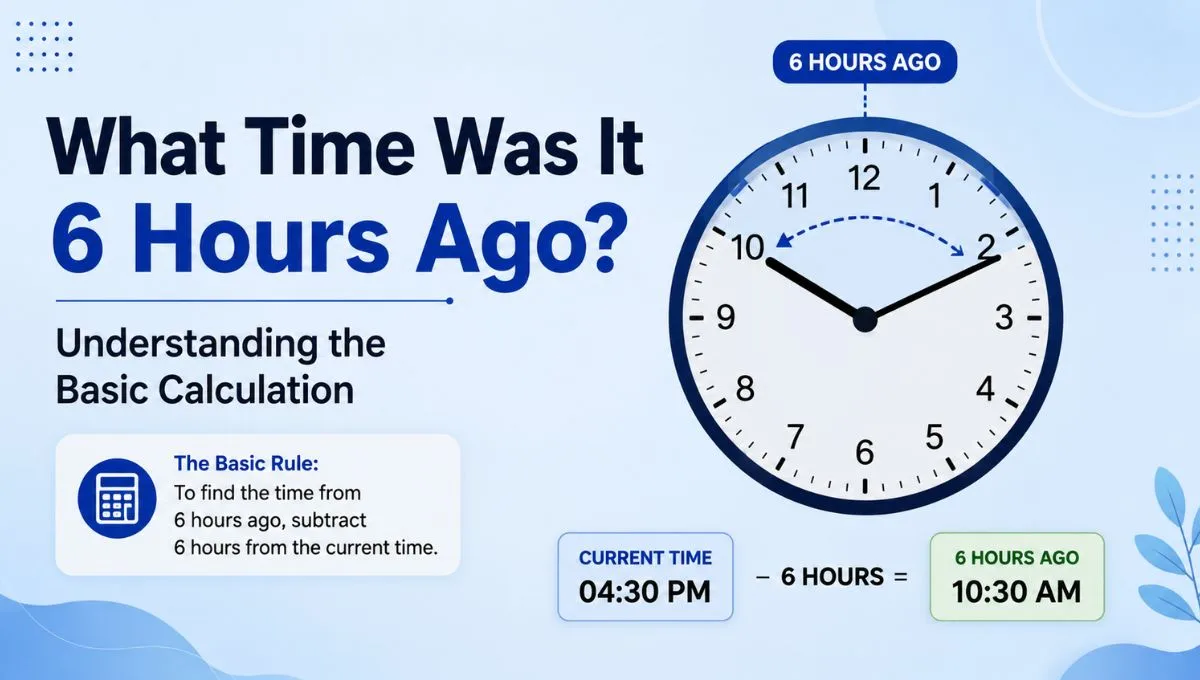
At its core, finding 6 hours ago is simple subtraction. Take the current clock reading and subtract six hours from it.
For example:
- If it’s 7:59 AM now, six hours earlier was 1:59 AM.
- If it’s 4:00 PM now, six hours earlier was 10:00 AM.
- If it’s 2:30 AM now, six hours earlier was 8:30 PM the previous day.
This process is called time subtraction, one of the most common forms of time calculation. It sounds technical, but it’s really just moving backward along a clock.
Many people use an hours ago calculator because crossing midnight can make mental math a little messy not hard, just tiring.
One key rule: the minutes stay the same. Only the hour moves backward.
Why People Search “What Time Was It 6 Hours Ago”
Most searches for this phrase come from everyday, practical needs rather than curiosity alone. People want a fast, reliable answer without doing mental math under pressure.
Common reasons include:
- Checking when a text or notification was actually sent
- Verifying work shift start times or overtime logs
- Coordinating with someone in a different time zone
- Answering “what time was it 6 hours ago from now” for travel planning
These situations often involve urgency, so people prefer a quick, accurate answer over a lengthy explanation.
What Time Was It 6 Hours Ago? Real-World Examples
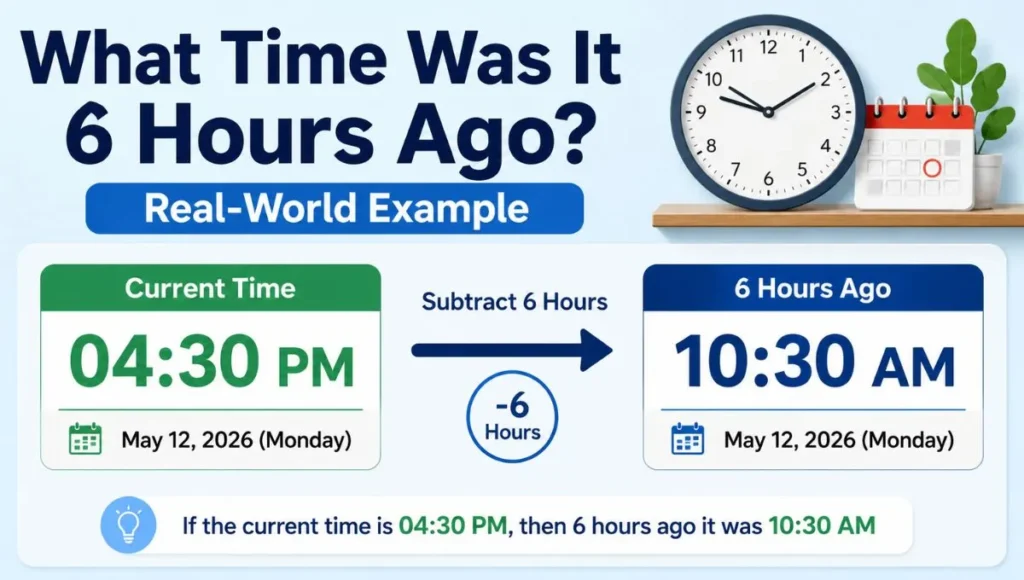
| Current Time | 6 Hours Ago |
| 9:00 AM | 3:00 AM |
| 12:00 PM (noon) | 6:00 AM |
| 3:30 PM | 9:30 AM |
| 6:00 PM | 12:00 PM |
| 11:45 PM | 5:45 PM |
| 2:00 AM | 8:00 PM (previous day) |
Notice how, in the last example, subtracting six hours pushes the time into the previous day. This is one of the trickiest parts of the calculation, and we’ll cover it in more detail shortly.
What Time Was It 6 Hours Ago From Now (DateTimeGo Style Lookup)
Many online tools, similar to DateTimeGo-style calculators, let you type in your current time and instantly see the result for six hours earlier. They detect your device’s local time, subtract 360 minutes, adjust the date across midnight, and display the result in 12-hour or 24-hour format — removing guesswork for anyone juggling multiple time zones.
Read Also: How Long Until 3:15 PM?
The Mathematics Behind Six Hours Earlier
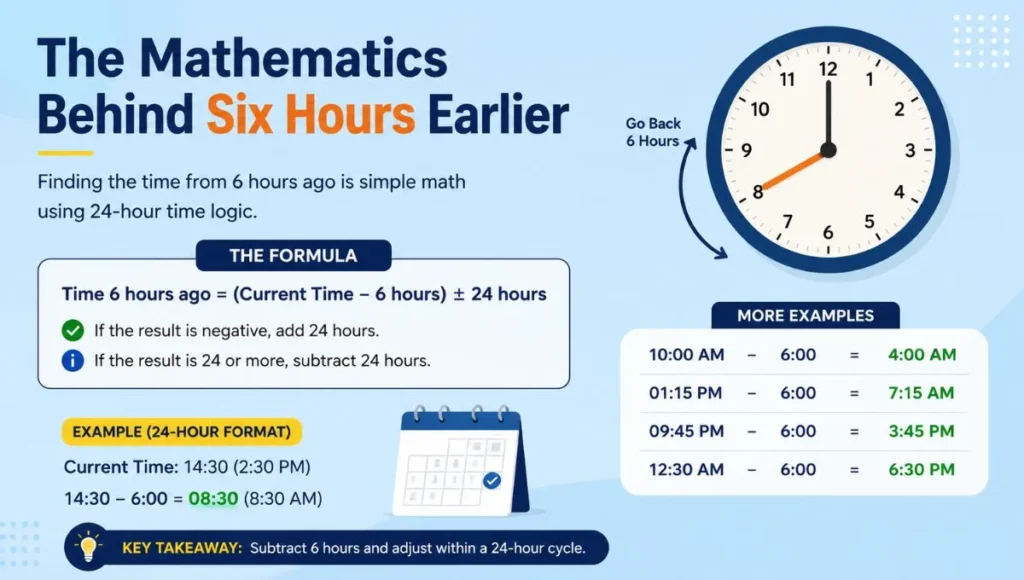
At its core, this is basic subtraction on a 24-hour cycle:
Past Time = Current Time − 6 hours
If the result goes below zero, add 24 to correct it and move the date back one day. Example: 3:00 − 6 = −3, then −3 + 24 = 21:00 (9:00 PM the previous day).
The same principle applies to any hour offset — six simply replaces whatever number you’re subtracting.
What Time Was It 6 Hours Ago on a 12-Hour vs 24-Hour Clock?
The math is identical either way, but formatting differs.
| Clock Type | How Subtraction Works | Example |
| 24-Hour Clock | Simple subtraction, no AM/PM needed | 18:00 → 12:00 |
| 12-Hour Clock | Subtract, then check if AM/PM flips | 3:00 PM → 9:00 AM |
On a 24-hour clock, every hour has a unique number, so there’s no ambiguity. On a 12-hour clock, watch for the AM/PM switch, especially near noon or midnight.
How to Calculate What Time It Was 6 Hours Ago Across Midnight
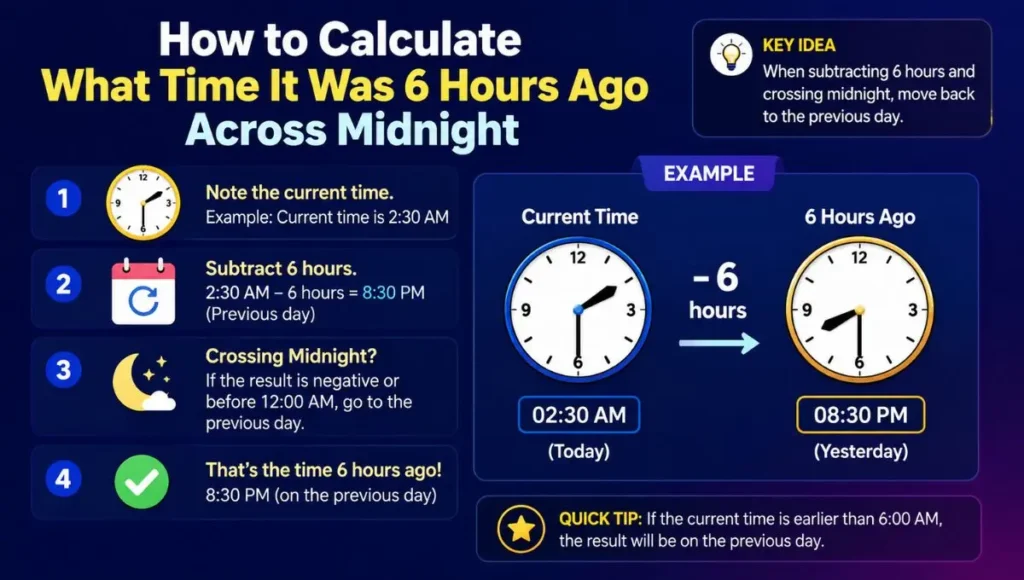
This is where most mistakes happen. A simple step-by-step method:
- Convert the current time to 24-hour format.
- Subtract 6 from the hour value.
- If negative, add 24 and subtract one day from the date.
- Convert back to 12-hour format if needed.
Example: If it’s 2:00 AM Tuesday, six hours earlier was 8:00 PM Monday not Tuesday. Forgetting to shift the date back is the most common error.
Read Also: How Long Until 2:45 PM?
Converting 6 Hours Into Other Units
Sometimes it helps to see six hours expressed differently:
- 6 hours = 360 minutes
- 6 hours = 21,600 seconds
- 6 hours = 0.25 days
These conversions are handy when programming countdowns or comparing durations across systems.
Understanding Relative Time
This phrase is an example of relative time — a reference point tied to the present moment rather than a fixed date. Unlike an absolute timestamp, it changes constantly because “now” keeps moving forward.
Time Zones and Why They Matter
Time zones add another layer of complexity. Six hours earlier in London is not the same clock time as six hours earlier in New York or Tokyo, since each location starts from a different baseline.
- Confirm whether you’re calculating in local time or UTC
- Daylight saving changes can shift the offset by an extra hour
- International teams often standardize on UTC to avoid confusion
Always double-check the applicable time zone before finalizing a six-hour calculation.
Tools That Help Calculate Hours Ago
While mental math works for simple cases, dedicated tools speed things up:
- Online “hours ago” calculators that auto-detect your current time
- Smartphone clock apps with world clock features
- Spreadsheet formulas for subtracting time values
These help most when repeating the calculation often or applying it to large data sets.
Common Mistakes When Calculating Past Time
Even a simple subtraction can go wrong. Watch for these frequent errors:
- Forgetting to change the date when crossing midnight
- Mixing up AM and PM after subtraction
- Ignoring time zone or daylight saving differences
Avoiding these mistakes keeps your result accurate every time.
What Time Was It 6 Hours Ago? Comparing Different Hour Offsets
| Offset | Example (Current: 3:00 PM) | Result |
| 1 hour ago | 3:00 PM − 1 | 2:00 PM |
| 3 hours ago | 3:00 PM − 3 | 12:00 PM |
| 6 hours ago | 3:00 PM − 6 | 9:00 AM |
| 12 hours ago | 3:00 PM − 12 | 3:00 AM |
| 24 hours ago | 3:00 PM − 24 | 3:00 PM (previous day) |
Six hours sits between short-term checks and half-day comparisons, making it a common reference point for work shifts and daily routines.
What Time Was It 6 Hours Ago From Now in Different Daily Scenarios
- Remote workers confirming when a colleague sent a message overseas
- Night shift employees tracking when their shift actually began
- Parents working out feeding schedules for infants
- Travelers adjusting to a new time zone after a flight
In each case, the underlying question is the same: what was the clock time six hours before a specific event?
Clocks, Human Perception, and the Feeling of Six Hours
Six hours often feels shorter or longer depending on context — brief as sleep, endless as a wait. This perception gap is why people double-check the math rather than trust their internal sense of time.
How Technology Uses Time Calculations
Modern apps rely heavily on hour-based subtraction behind the scenes — server logs timestamp events in UTC before converting to local time, and social platforms show “posted 6 hours ago” instead of a fixed clock time because relative time is more intuitive at a glance.
Future Time Versus Past Time
| Direction | Formula | Example |
| Past (Ago) | Current Time − 6 hours | 4:00 PM → 10:00 AM |
| Future (From Now) | Current Time + 6 hours | 4:00 PM → 10:00 PM |
The math mirrors itself, but the date shift reverses — subtracting can move you to the previous day, while adding can push you into the next.
Read Also: How Long Until 4:00 PM?
Practical Situations Where Knowing Six Hours Earlier Matters
Beyond curiosity, this calculation has real professional value:
- Compliance teams verifying timestamped records
- Customer support confirming when a ticket was filed
- IT teams troubleshooting outages using server logs
Accuracy matters here, since even a small miscalculation can lead to incorrect conclusions.
Quick Mental Method for Finding the Time 6 Hours Ago
If you don’t want a calculator, try this shortcut:
- Note the current hour.
- Subtract 6 directly if the hour is 6 or higher.
- If below 6, subtract anyway, then add 12 and flip AM/PM.
- Adjust the date backward if you crossed midnight.
With practice, most people can calculate six hours ago in their head within seconds.
Frequently Asked Questions
What time was it 6 hours ago today?
To find what time it was 6 hours ago today, simply subtract 6 hours from the current local time. For example, if it is 8:00 PM right now, then 6 hours ago it was 2:00 PM.
What was 6 hours from now?
If you want to know what time it will be 6 hours from now, add 6 hours to the current time. For example, if it is 9:00 AM now, then 6 hours from now will be 3:00 PM.
It is 7:15 — what time was it 6 hours ago?
If the current time is 7:15, then 6 hours ago it was 1:15. Just subtract 6 from the hour while keeping the minutes the same.
What was 6 hours ago from now yesterday?
“6 hours ago from now yesterday” usually means taking the current time, going back to the same time yesterday, and then subtracting another 6 hours. This can be useful when comparing times across two different days.
What time was it 6 hours ago from now?
To calculate 6 hours ago from now, subtract 6 hours from the present time. A time calculator or live “6 hours ago” tool can do this instantly without manual math.
What was 6 hours ago in EST?
To find 6 hours ago in EST, use the current Eastern Standard Time and subtract 6 hours. Be sure to account for daylight saving time if you are checking a date when EST changes to EDT.
What was 6 hours ago from 4 AM?
If the starting time is 4:00 AM, then 6 hours earlier was 10:00 PM on the previous day. When subtracting across midnight, the date changes as well.
What was 6 hours ago in CST?
To calculate 6 hours ago in CST, subtract 6 hours from the current Central Standard Time. This is helpful when checking schedules, meetings, or deadlines in the CST time zone.
Conclusion
Understanding what time it was 6 hours ago is a small but genuinely useful skill, whether you’re checking logs, coordinating time zones, or satisfying curiosity. The math stays consistent: subtract six hours, watch for date changes, and adjust AM/PM when needed.
Once you know the formula, you can apply it to any hour offset with confidence. Online calculators remain a handy backup whenever you want an instant, error-free answer.

I’m an experienced content writer with 7 years of experience creating heartfelt messages, prayers, wishes, quotes, and inspiring content. At Trendzmsg, I focus on providing readers with meaningful, engaging, and original content to help them express their emotions, share happiness, and celebrate special moments with loved ones.